








The Case Against Horse-Drawn Carriages

Horse-drawn carriages are not the desirable trip down "memory lane" that they are portrayed to be. Instead, they present potentially serious threats to the safety of both people and horses.

The risk of accidents
Mixing horse-drawn vehicles with pedestrians and motor vehicle traffic is inherently dangerous. Contrary to operator's claims, most horses are not at all comfortable working among cars and trucks. Horses can easily be "spooked" — no matter how well trained they may be. Horses may become startled by sudden noises like sirens, horns, motorcycles and thunder, and cause accidents by running into traffic or onto sidewalks.

A survey of carriage horse accidents in the U.S. revealed that:

  • 85% of all accidents were the result of horses being spooked.
  • 70% of accidents resulted in injury to a carriage driver, passenger and/or bystander.
  • 22% of accidents resulted in a human death.

Serious injuries resulting from collisions between cars and carriage horses have occurred in almost every city that allows carriage horse rides. For example, the city of St. Augustine has had 16 published accidents involving horse-drawn carriages since 1996.


Horse Welfare

Visible injuries
Holly Cheever, a respected equine veterinarian who has treated carriage horses in New York City, has testified that, "Lameness and hoof deterioration are inevitable when a horse spends his or her life walking or jogging on the unnaturally concussive asphalt of city streets." Ill-fitting harnesses cause skin sores, bone bruising, neck, shoulder and back problems. Cruel bits cause painful mouth, teeth and gum problems.

Dehydration
In Florida's blistering heat and humidity, horses suffering from dehydration or heat stress can die in just a few hours. Symptoms of heat prostration in horses include flared nostrils, brick-red mucus membranes, trembling and a lack of sweat production on a hot day. The dangerous effects of high temperature and humidity is magnified by pavement temperature that is often 50 degrees hotter than the air. A horse's ability to sweat actually collapses as the combined heat and humidity exceeds 150 degrees during the hot summer months.

Toxic pollution
Air pollution has an adverse effect on horse's respiratory systems. The effect of the Florida sun on pollution generated by vehicle exhaust can create toxic low-level ozone smog. As a result, horses forced to pull carriages in traffic draw in huge lungfulls of toxins. Veterinarian Jeffie Roszel has studied the breathing problems experienced by horses forced to pull vehicles in traffic. He found that the "tracheal washes and samples from respiratory secretions of these horses showed enormous lung damage, the same kind of damage you would expect from a heavy smoker." Horse's nostrils are usually only 3 to 3.5 feet above street level, so these animals are truly living "a nose-to-tailpipe existence."


The Animal Rights Foundation of Florida is committed to working with city officials to ban horse-drawn carriages wherever they are present. Pressure from concerned residents and tourists has resulted in bans on carriage horses in a number of Florida cities, including Palm Beach, Hollywood, Key West, Pompano Beach, Deerfield Beach, Treasure Island and Panama City Beach.

What You Can Do 
Contact your government officials. Urge them to ban carriage horse rides in your community. If you see a carriage horse in distress, contact the police department, animal control and/or the local humane society.
Join ARFF in our campaigns against the carriage horse industry in the City of St. Augustine and elsewhere.


St. Augustine Carriage Horses Need Your Help!
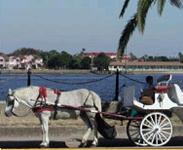
Horses pulling heavy carriages are a sad but unfortunately common sight on St. Augustine's busy streets. In recent years, there have been several accidents involving horse-drawn carriages in St. Augustine, resulting in injuries to tourists, carriage drivers and horses.

ARFF has proposed minimum requirements be adopted by the City of St. Augustine to protect horses forced to pull heavy carriages in extreme heat and humidity. However, despite expert testimony and meetings with the Mayor and other city officials, we have failed to provoke any evidence of compassion by elected officials. ARFF continues to urge the city to adopt the following basic protections for carriage horses:

  • Allow horses to work only after 5 pm in the summer,
  • Regulate the length of time horses are forced to work, and
  • Ensure horses are provided with an adequate amount of clean, fresh, cool water.

You Can Help!
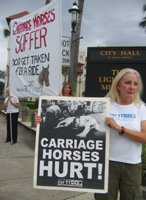
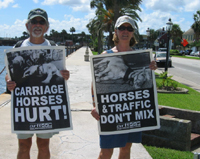
Join ARFF as we speak up for the horses. ARFF frequently holds demonstrations against the cruel carriage horse industry in St. Augustine. Visit our Events Calendar for future dates.

Please contact the Mayor and commissioners and ask them to follow the lead of other progressive cities and enact an ordinance prohibiting horse-drawn carriages, thus ensuring the safety of both horses and people.

Contact:
Mayor Joseph L. Boles
City of St. Augustine
P.O. Box 210
St. Augustine, FL 32085
E-mail: cosa@aug.com

St. Augustine City Commission:
Don Crichlow, Vice Mayor/Commissioner
Susan Burk, Commissioner
Errol D. Jones, Commissioner
George Gardner, Commissioner


Update, September 2007: The City of Altamonte Springs will not be sponsoring horse and carriage rides this holiday season.

Altamonte Springs
During the winter "Holiday Season" in 2006-07, the Uptown Altamonte development offered free horse-drawn carriage rides. There is nothing less romantic than seeing a poor horse drag people around in a carriage.

Please contact Uptown Altamonte and ask them politely not to bring horse-drawn carriages back next holiday season. (Animal-friendly entertainment at the development includes live music, a water show and wine tasting.)

Contact:
Click here to use Uptown Altamonte's online comment form.

Please send a copy of your comments to Altamonte Spring's Mayor:
Mayor Russel Hauck. E-mail: rhauck@cfl.rr.com


Don’t Get Taken For A Ride In Delray Beach
In 2006, ARFF representatives met with the Mayor and commissioners of Delray Beach. We informed them of the dangers of permitting animal drawn carriages in their busy downtown area, submitted petitions of residents and tourists, and urged them to enact an ordinance banning these outdated contraptions. Unfortunately, the city has yet to agree to support such an ordinance.

You Can Help!
Please contact the Mayor and commissioners and ask them to prohibit carriage horse rides in the city. If you are not a resident of Delray Beach, tell them that you avoid cities that support the exploitation of animals for entertainment.

Contact:
Mayor Rita Ellis
City of Delray Beach
100 NW 1st Avenue
Delray Beach, FL 33444
E-mail: RitaEllis@MyDelrayBeach.com

Delray Beach City Commission:
Vice-Mayor Fred Fetzer
Deputy Vice-Mayor Brenda Montague
Commissioner Gary Eliopoulos
Commissioner Woodie McDuffie


Carriage Horses in Downtown Orlando

In November 2005, the City of Orlando quietly and unlawfully passed an emergency ordinance to increase the number of horse-drawn carriage operators in the city’s busy downtown area. ARFF filed a lawsuit challenging the ordinance, which was passed in such a manner so as to avoid public input. ("Horses Get Day In Court"— click to read ARFF's Press Release about our lawsuit against the City of Orlando.)

On March 7, 2006, horses in the cruel carriage industry were handed a victory when an Orange County judge determined that the City of Orlando had illegally enacted the ordinance allowing horse-drawn carriages. (Read the article in the Orlando Sentinel, "Hold your horses, Orlando is told.") Thanks to ARFF's litigation, those concerned about the inherent dangers and cruelty associated with horse-drawn carriages were provided the opportunity to address the city council.

Unfortunately, after two public hearings, the city council voted in early April 2006 to allow horse-drawn carriages back to the streets of downtown Orlando. At the hearings, ARFF representative Bryan Wilson spoke on behalf of horses who are forced to pull heavy carriages in Florida’s blistering heat and humidity. We would like to thank those ARFF members who attended the meetings, and everyone who contacted the city council concerning this issue. Although ARFF is disappointed with the city's decision, we will continue to work with Mayor Dyer and the city council to adopt minimum requirements protecting carriage horses and the public (read our press release, "Regulatory Legislation Is Necessary to Safeguard Horses’ Welfare").

You Can Help
Please write a polite letter to the Mayor and urge him — for the welfare of horses and the safety of the public — to
adopt ARFF's suggested standards.

Contact:
Mayor Buddy Dyer
E-mail: Buddy.Dyer@CityofOrlando.net


1431 N. Federal Highway Fort Lauderdale, Florida 33304 (954) 727-ARFF